Photographing the Meteora sunset
The light at Meteora changes fast in the last hour, and the viewpoint is shared with everyone else who came for it. These nine tips cover the camera side and what the tours give you to work with. None of them can clear a cloudy sky, sadly.
What a sunset tour gives a photographer
On Visit Meteora's sunset tour, the day ends at a viewpoint near Roussanou after several stops on the way. Meteora Trip's itinerary gives its sunset viewpoint 30 minutes, which is a generous slot for one spot of light.
That leaves room for a handful of careful frames, not for a long tripod session. Plan your shots before the minibus parks, and the tips below are sorted so you can run through them in order.
Check when the sun sets for the month you travel, since the local tours move their start time with it. A winter tour reaches the viewpoint by late afternoon, a summer one in the evening.
Light and timing
1. Shoot the golden hour, not only the sun
The warmest color tends to come in the last hour before the sun touches the hills, which photographers call the golden hour. Low side light brings out the texture of the pillars and the monastery walls.
2. Stay 15 minutes after the sun drops
Many people pack up the moment the sun disappears. Wait another 15 minutes, because the sky often deepens to pink and violet while the rocks go dark, and that gives clean silhouettes.
3. Read the haze before you shoot
Clear air gives crisp rock edges, while mist and cloud can hide the view altogether, as one guest on an Athens day trip found. When haze lies in the valley, frame the layers of pillars fading into it instead of fighting it.
Lenses and camera settings
4. Pack a wide lens and a short tele
A wide lens takes in the whole row of pillars from a viewpoint. A short telephoto pulls a single monastery out of the scene and stacks the rocks behind it, which makes the cliffs look as steep as they feel.
Phones with a 2x or 3x lens do the tele job well enough for sharing. Keep the digital zoom for emergencies, since it softens the rock detail quickly.
5. Expose for the sky
Meter on the bright sky beside the sun, not on the dark rocks, or the color washes out. Most cameras and phones let you tap or dial the exposure down a step, and the rocks turn into silhouettes that suit the scene.
The tour that ends near Roussanou
Visit Meteora's 4-hour small-group tour with hotel pickup in Kalambaka and Kastraki, one monastery, the hermit caves and the sunset at a viewpoint near Roussanou. Pack cash for the fees and a spare battery.
6. Switch to night mode on a phone after sunset
Once the sun has gone, a phone's night mode keeps detail in the dark rock while holding on to the color overhead. Rest the phone on your bag or a flat stone and keep still for the few seconds it needs.
7. Keep the horizon level
The rocks rise straight up, so a tilted frame shows at once. Turn on the grid lines in your camera or phone and line up the far hills before you press the shutter.
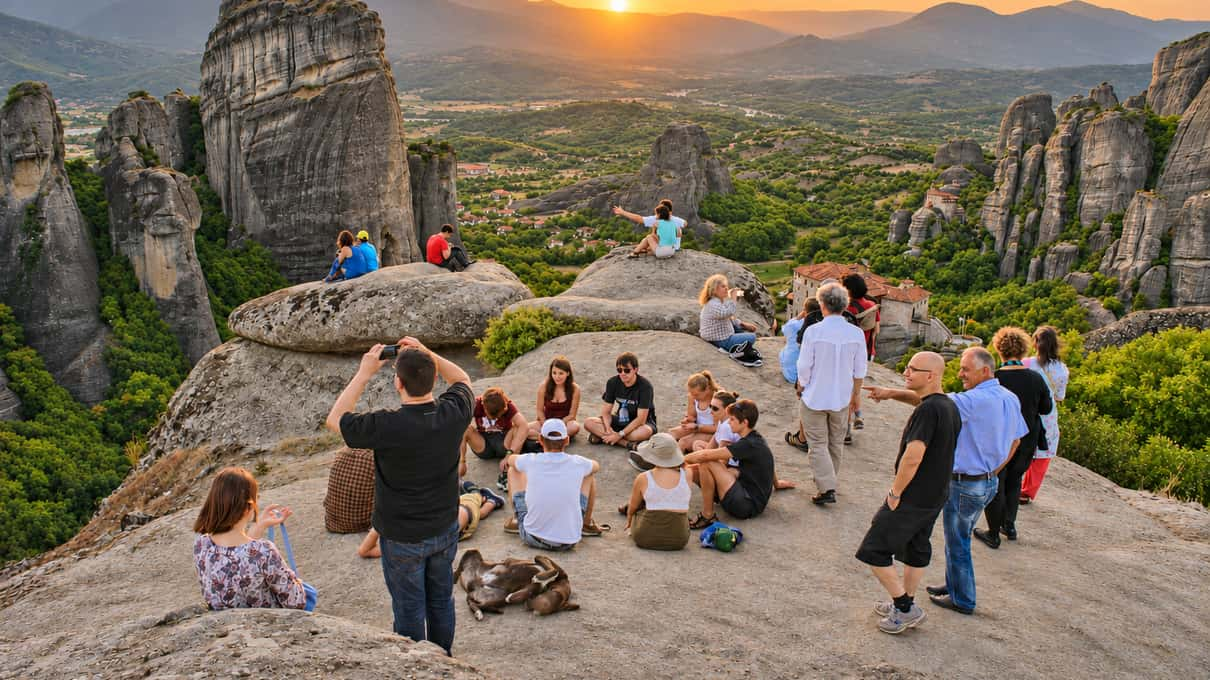
People and the viewpoint
8. Let the guide take the group shot
Reviewers of Visit Meteora's local tour say the guides take photos at each viewpoint, and riders on the horse tour praise the pictures taken for them. Hand over your phone for the portrait, then use your own camera on the landscape while the light lasts.
9. Leave room for others and keep back from the edge
The viewpoints are shared, and some of their cliff edges have no railings. Take your spot early, stay a step back from the drop, and never climb out onto a ledge for a better angle.
If you hope to fly a drone, ask first, because we did not check the rules. Inside the monasteries, ask before taking any photo, since the monks and nuns live there and we have not checked each house's rule.
What to carry for an evening shoot
A spare battery and a charged phone matter more than extra lenses, as the cold drains batteries faster in winter. A small cloth helps too, since dust and the odd drizzle land on the lens.
Warm layers keep your hands steady when the wind picks up at the viewpoints after dark. Our page on what to wear covers clothing for the monastery and the evening together.
The local tours visit a monastery and the hermit caves before the viewpoint, so save some battery for the evening. Our page on which monasteries you enter lists the stops on each option, so you know where the light will find you.
Which tour suits a photographer
For time with the light, the two local tours end at viewpoints every day of the year. Our pick of the Meteora sunset tours has the most reviews among the local ones, and Meteora Trip's tour lists 30 minutes at its viewpoint.
The e-bike and horse tours give a moving view instead, compared on our e-bike or horse page. The Athens trips add the sunset only from November to March, and winter mist may still win, so read the best time to go before choosing dates.
Whichever you book, compare the six sunset options on start time and pickup first. A good frame of the sun setting over Meteora starts with being at the right rock at the right hour.